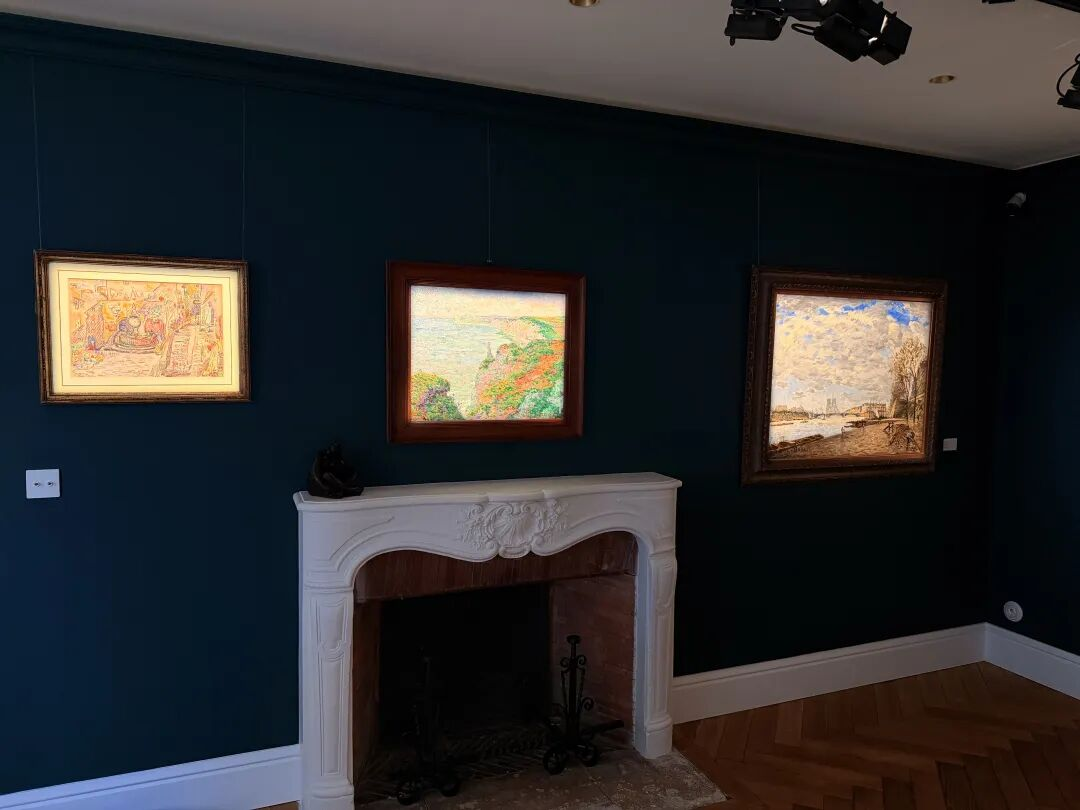
Claude Émile SCHUFFENECKER (1851-1934)
Falaise d’Etretat, 1887
Huile sur toile
Signée et datée en bas à droite
50 x 60,5 cm
Provenance:
Private collection in Paris;Fonseca Fine Art
In 1872 Claude-Emile Schuffenecker joined the stockbroking firm of Bertin in Paris as an accountant, where he met and befriended his colleague Paul Gauguin. They shared a common passion for art, going on trips together to the Louvre to study the works of the Old Masters. Schuffenecker took drawing classes, socialised with his artistic contemporaries, including Armand Guillaumin and Camille Pissarro, and made his Salon début in 1874. When the stock market crashed in 1882, Schuffenecker abandoned his financial career to devote himself entirely to painting. As one of the co-founders of the Salon des Indépendants in 1884, he befriended Georges Seurat, who would have an important impact over his artistic style for the remainder of that decade. Despite Schuffenecker's close relationship with Gauguin and members of the Pont-Aven group, his artistic sensitivities were much more in harmony with the Neo-Impressionist theories and technique developed by Georges Seurat and Paul Signac. Schuffenecker's interpretation of the pointillist technique resonated with his desire to reflect in art the ephemeral yet divine nature of the world as a symbol of the human condition.
Schuffenecker's most accomplished works in this style date from summers spent at Étretat and Yport on the Normandy coast from the mid to late 1880s, and the present work exemplifies how he successfully adapted this technique to express his own personal vision. Greatly inspired by these coastal towns, he gloried in the play of light over the cliffs, the sea and the sand. The dramatic perspective in Falaises d'Etretat places the viewer by the cliff wall looking outwards over the shimmering sea, a bold splash of red on the cap of the young boy perched on a small rock announcing the only human presence. In this striking composition, Schuffenecker employs his usual palette of light greens, blues, purples and oranges, but suffuses it with white pigment to heighten the ethereal effect. Count Antoine de la Rochefoucauld, art collector, patron and artist, described Schuffenecker's approach: 'He, who more than anyone has a perpetually agitated soul, has created works of sheer joy.
Claude-Émile Schuffenecker (8 December 1851 – 31 July 1934) was a French Post-Impressionist artist, painter, art teacher and art collector. A friend of Paul Gauguin and Odilon Redon, and one of the first collectors of works by Vincent van Gogh, Schuffenecker was instrumental in establishing The Volpini Exhibition, in 1889.
Early Life and Artistic Formation
Born in Frèsne Saint-Mamès (Haute-Saône) to Nicolas Schuffenecker, a tailor hailing from Guewenheim (Alsace), Émile’s childhood was marked by tragedy when his father succumbed to tuberculosis shortly after his birth. His mother remarried, relocating to Meudon, near Paris, where she found employment at a laundry and fostered connections with her maternal family. Educated by the frères des écoles chrétiennes, Schuffenecker embarked on a career path that intertwined commerce and artistic pursuits—working initially in his uncle’s chocolate and coffee-roasting facility before securing a position at Bertin, the prestigious Parisian broker. It was here he forged an enduring friendship with Paul Gauguin, sharing a passion for studying Old Masters at the Louvre and honing their skills at the Académie Colarossi. This formative period instilled in Schuffenecker a profound appreciation for Impressionist aesthetics and established him as a key figure within the bohemian circles of Paris.
The Influence of Gauguin and Van Gogh
Schuffenecker’s artistic sensibilities were decisively shaped by his relationship with Gauguin, whose bold experimentation with color and form served as an inspiration. However, Schuffenecker's gaze was particularly captivated by Vincent van Gogh—a fascination that extended beyond mere admiration for stylistic innovation. He became one of the earliest collectors of Van Gogh’s paintings, demonstrating a genuine enthusiasm for the artist’s expressive vision and unwavering commitment to capturing the essence of nature. This devotion fueled his own artistic explorations, resulting in landscapes imbued with atmospheric haze and luminous color palettes—a direct reflection of Van Gogh's groundbreaking techniques.